 Here is an excerpt from an article written by for Harvard Business Review. To read the complete article, check out others, sign up for email alerts, and obtain subscription information, please click here.
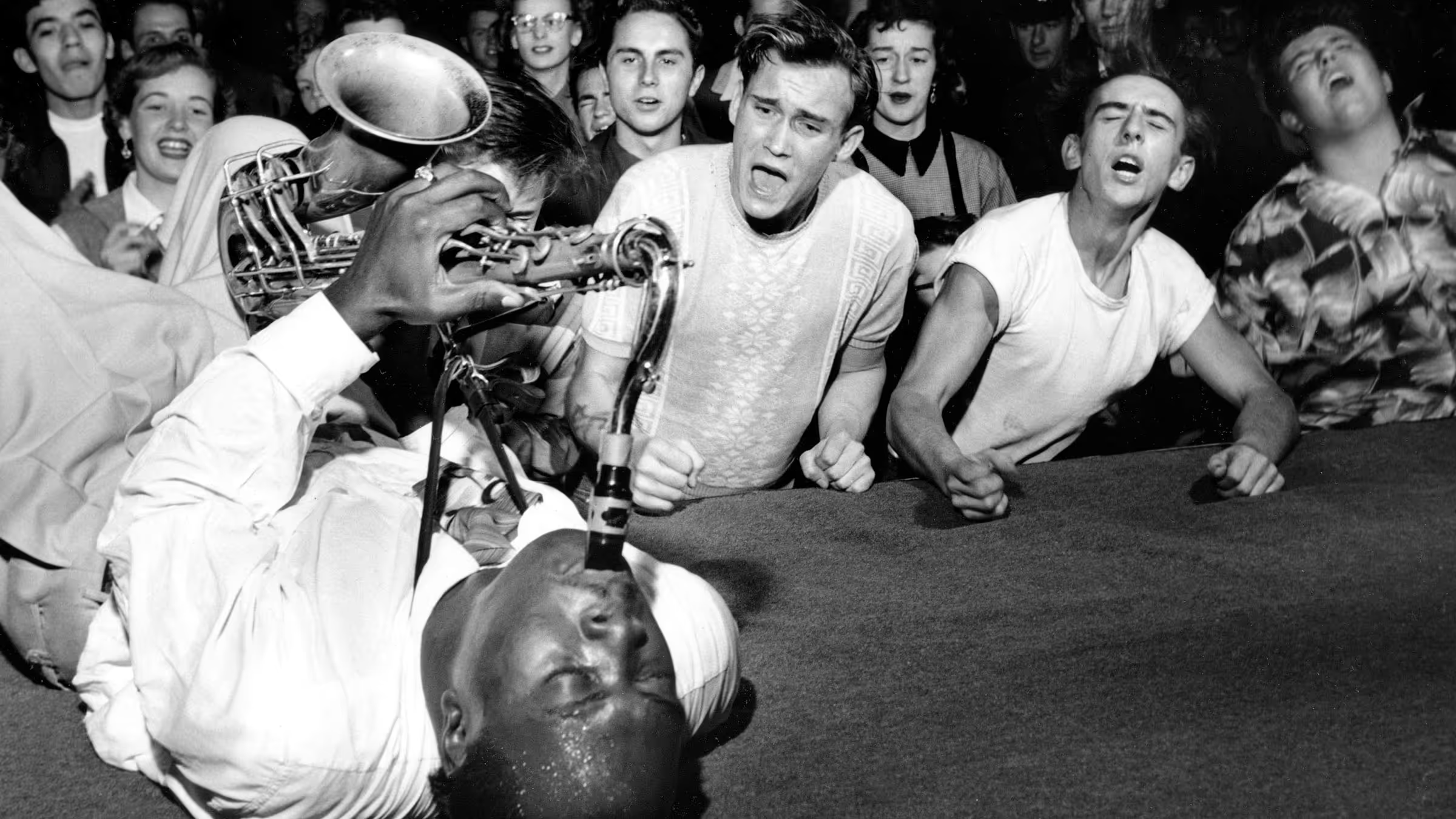
Illustration Credit: Bob Willoughby/Getty Images
* * *

The goal of any corporate leader is to effect behavioral change: to move people to achieve certain outcomes. For employees, those outcomes might include high engagement and performance; for customers, purchasing decisions; and for both, loyalty and advocacy (being willing to recommend working for or doing business with the organization). By those standards, leaders today are struggling. Although business leaders have focused for decades on engagement and loyalty and, more recently, on employee (and customer) experience, employee trust levels are at all-time lows and engagement levels are at the bottom of a 20-year range. At the same time, customers are more demanding and more fickle. They expect immediate fulfillment, effortless returns, and products tailored precisely to them—and they will walk away quickly if those expectations aren’t met.
Perhaps not coincidentally, companies (in which our confidence has collapsed) have lately made an abrupt about-face. They’re now doubling down on transaction and extraction. Employees, reduced to “head count,” are treated as dispensable, even as work reaches far more deeply into personal lives than ever before, as workplaces monitor employees’ opinions on social media, and communications technologies keep workers tethered to work at all hours. Meanwhile, customers are “eyeballs” or “average basket size.” And although consumers can summon almost anything with the tap of a screen, meaningfully personalized products feel vanishingly rare. Increasingly, whether as employees or consumers, our interactions with companies are stripped of humanity; where once we found human connection we now get ensnared in process, policy, and technology, including AI. At this time of economic and geopolitical uncertainty, everything is abundant, but nothing has our back. Thus, it’s hardly a surprise that the people whose loyalty we seek feel increasingly alienated and unmoored.
Faced with this landscape, what can leaders do to generate sustainable high performance, loyalty, and resilience from their people and genuine commitment from their customers? And what critical capability must leaders develop to stop the drift and instead lift their teams and their customers up into a world that’s more productive for all?
Most leaders, I believe, are looking for answers in the wrong place. There’s a deeply held management belief that the key to growth is fixing what’s broken. But for more than 25 years my research has found that the opposite is true: Focusing on improving deficiencies produces compliance at best—and disengagement at worst. In reality, people and organizations grow by building on their strengths.
* * *
Looking to what an employee or customer loves is not a distraction. Far from it, because love is the experience that most reliably creates change. Love, the quantitative and qualitative research record reveals, is the most powerful force in business, and experience intelligence is the leadership capability that businesses, and I believe society, need our leaders to cultivate, now more than ever.
This article is adapted from Design Love In: How to Unleash the Most Powerful Force in Business (Harvard Business Review Press, 2025), by Marcus Buckingham.
* * *
Here is a direct link to the complete article.