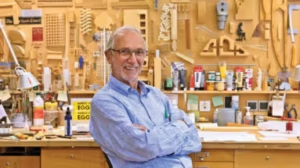
Piano in the model workshop of his Paris office in 2016.
Here is an excerpt from an article written by for Harvard Business Review. To read the complete article, check out others, sign up for email alerts, and obtain subscription information, please click here.
Illustration Credit: Stefano Goldberg
* * *
Born into a family of Genoan builders, Piano rebelled—but only slightly—by leaving home to study architecture in Florence and Milan. In 1971, he and Richard Rogers opened a London firm and soon won a prestigious commission: to design the Centre Pompidou in Paris. In 1981, Piano created his own “building workshop,” which has in the ensuing decades completed notable projects such as Kansai airport in Osaka, the Shard in London, and the Whitney Museum in New York. Now in his late eighties, he still works full time.
Why did you choose architecture over the family construction business?
There was no doubt that I wanted to be somebody who made buildings. I spent a lot of time on site with my father. He was a small builder with maybe 12 workmen—always very elegant with the jacket, the hat–and he controlled everything. When you are age eight or so and watch, you understand that there’s magic in construction. You have raw materials one day and something standing up, straight and solid, the next. But when you’re 18, you want to run away from home, so I studied architecture in Florence and Milan to be different from my family. It’s a simple story. When I told my father I wanted to be an architect, he said, “But why? The builder gets to it all, not just the design.” Still, I remained in the art of building.
Did that early exposure to building influence the way you work as an architect?
Very much. I never understood the difference between architect, engineer, or builder. Even my office is called Renzo Piano Building Workshop, and we have all the people you need to make a building. In this line of work, you cannot separate theory from practice. I, myself, am still very attracted to the site and the construction. But of course, when you go to architecture school, you learn very quickly that it’s about more than good, functional, solid construction. You also need to be a humanist, who makes places for people to meet and share enjoyment. Architecture is the art of answering both needs and desires. There’s a poetry to it—a magic that turns a building into a place people love to be.
Who were your architectural role models?
In history, Brunelleschi, the 15th century Italian architect. He was an artist but also a builder. He designed instruments and tools. He knew the soul of a building and how to make things. The famous cupola of Santa Maria del Fiore in Florence was full of invention in terms of science, organization, and the technique of putting things together without using scaffolding. Of course, my father was also a role model for me, and then Eero Saarinen, Frei Otto. I have so many. As an architect, you have to learn from all those people who not only make buildings but also create emotion. My heroes have been always architects that put together construction, ethics, and poetry.
When you started, how did you win over clients?
It’s such a long time ago, I don’t remember! But I do have a few rules. I never do a job without spending time in the place because places talk. They have a little voice. So, when somebody ask me, “Do you want to do this or that?” my first answer is always, “Let’s see.” Then I talk to the client but also go to the place because there will always be a little genius hidden there—in the light, in the proportions. I probably did that for my first project, too, probably something very modest–maybe a doghouse for my aunt. But even now with big projects, I take the same approach. I go there, I talk to people, I walk around with a pencil and paper in my hands, taking notes and trying to catch the inspiration.
What inspired you to enter the Pompidou competition?
We were very young, living in London in the late 1960s and early 1970s, which was an incredible time of freedom and rebellion. We felt like the Beatles. And we wanted to make this project for Beaubourg, or the Centre Pompidou, with that spirit: We thought that culture should be part of society and wanted to make an urban machine, putting together a library, museum, music, and cinema. The competition was open to anyone, and they got 681 entries, so winning it was completely unexpected. We weren’t trying to win. We went in totally free-minded, a bit mad, a bit extreme. For example, our design was the only one that didn’t use the total space. I am Italian, and Richard was born in Italy, so we wanted a piazza. The brief didn’t call for that. It was completely our vision.
After winning such acclaim for that project, how did you think about the next steps of your career?
You don’t think. You just wait and see. After Beaubourg, I was very tired. It was a big, big job. So I went back to my passions, designing funny things and working on a historical center with UNESCO. This period was, by the way, not easy. Beaubourg had been such a strong statement that many clients were hesitant to hire us. Then Richard moved back to London, and I preferred to stay in Paris, so we split. But we’ve remained good friends, like brothers, our whole lives. My first job after that was for Dominique de Menil, who asked me to design a building for her art collection in Houston.
How has your creative process evolved over time?
The secret to longevity is a team. My office now has about 120 people, and some have worked with me for decades. That’s very important because you have a coherence and continuity that makes relationships so easy. Sometimes we don’t even need to talk; we just watch each other. But the office is also full of young people, so we grow new talent. It has a good range of age, experience, and capacity—and yet it’s not too big because I still want to know everybody.
* * *
Here is a direct link to the complete article.
Alison Beard is an executive editor at Harvard Business Review and cohost of the HBR IdeaCast podcast. She previously worked as a reporter and editor at the Financial Times. A mom of two, she tries—and sometimes succeeds—to apply management best practices to her household.