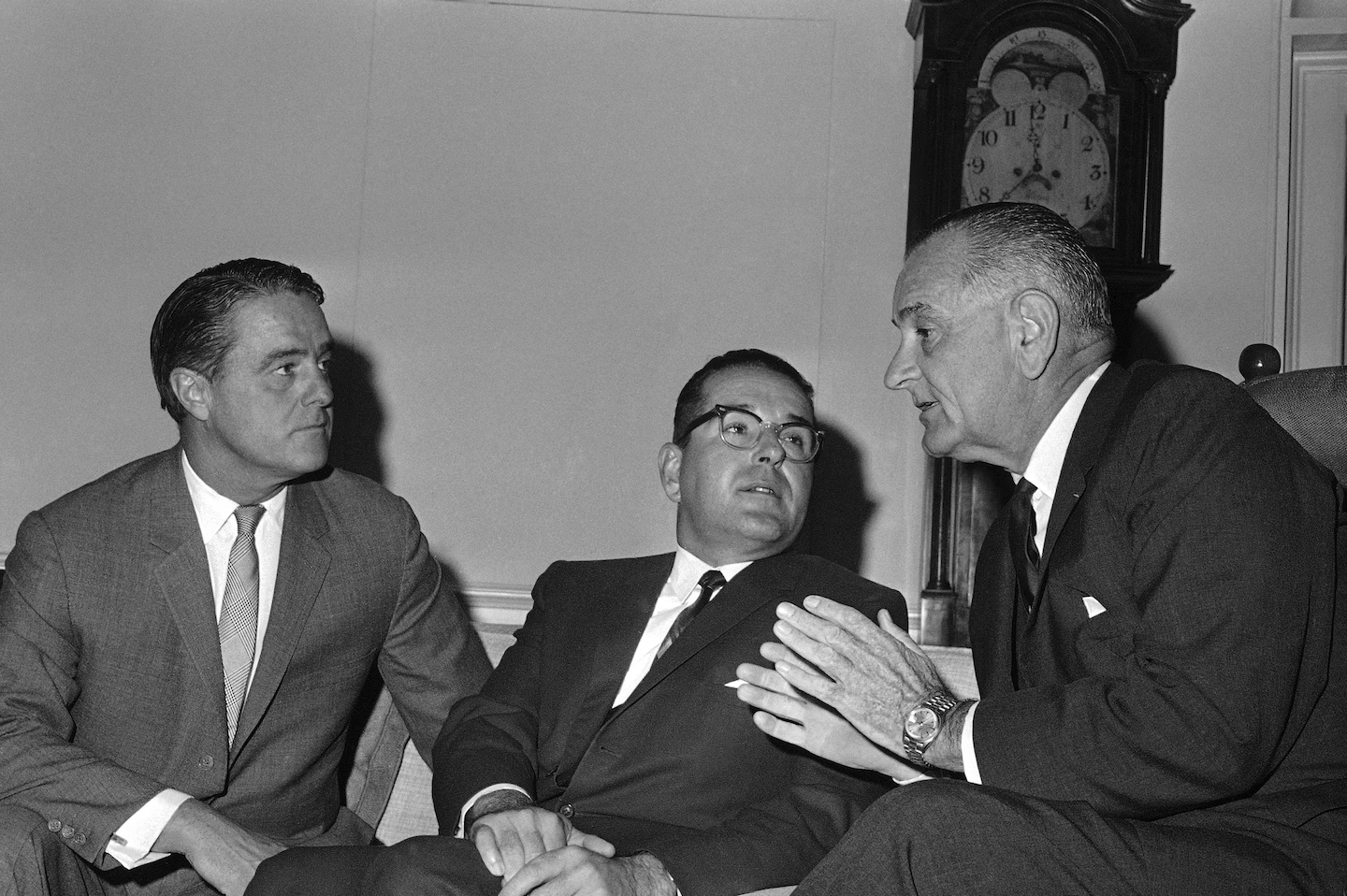
President Lyndon B. Johnson discusses his War on Poverty with Sargent Shriver, left, and Bernard Boutin, right, in 1965. (Anonymous/AP)
Here is a brief excerpt from an article co-authored by the Editorial Board of the Washington Post (June 8, 2026).
* * *
It provides some astonishing good news. Over that entire time span, no matter what baseline they chose, the absolute poverty rate fell by at least three-quarters. When including the value of health insurance, poverty fell by up to 97 percent.
The transformation was especially massive for African Americans. In 1939, 93.3 percent of Black children were in poverty. By 2023, it was 5.7 percent.
The story most Americans are familiar with would credit the reduction to the modern welfare state after President Lyndon B. Johnson announced the War on Poverty in his 1964 State of the Union address.
Burkhauser and Corinth’s research allows this claim to be tested. They find that poverty was already in rapid decline from 1939 to 1963, before the federal government’s war against it began. That decline was almost entirely due to rapid economic growth causing incomes to rise.
And the massive expansion of the welfare state didn’t change the downward trajectory of the poverty rate. “Poverty fell no faster in the 24 years after the War on Poverty was declared than in the 24 years before,” they write.
The poverty rate fell before the War on Poverty without significantly increasing working-aged people’s dependence on government. They calculate a “dependency rate,” defined as the percentage of people who receive less than half of their income from market sources.
The dependency rate was very low during the rise in living standards that predated LBJ’s Great Society programs, but it tripled by the mid-1990s. The welfare reform law signed by President Bill Clinton brought the dependency rate down, and poverty simultaneously declined due to strong economic growth. The decline in poverty after welfare reform was greatest among Black children.
Sadly, dependency on government grew again in the aftermath of the Great Recession and remains much higher today than when Johnson embarked on his Great Society initiatives.
It’s a failure by the standard that he set. “The War on Poverty is not a struggle simply to support people, to make them dependent on the generosity of others,” Johnson said in a March 1964 speech to Congress. His vision was for government to empower poor people to sustain themselves.
Burkhauser and Corinth don’t say the War on Poverty was pointless. It’s nearly impossible to know how different economic conditions would have been if the government had done something dramatically different. And their data show that taxes and transfers today significantly reduce the poverty rate.
* * *
Here is a direct link to the complete article in the Post.
I also urge you to check out David Beckmann’s Poverty’s Abolitionists: Faith Activism, and Hope for Difficult Times, published by Bloomsbury Academic (May 2026).