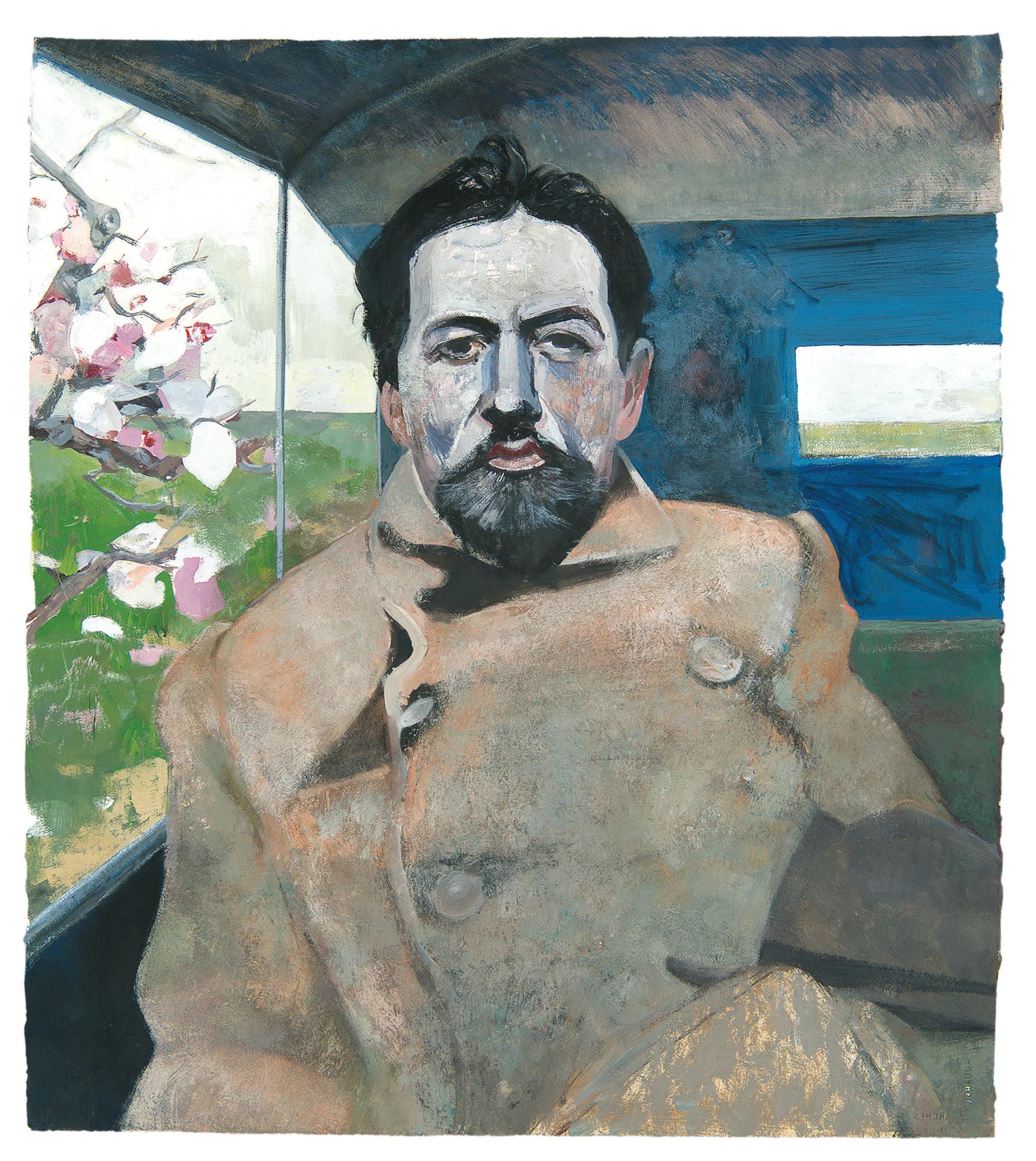
“I’m ending up with something rather odd and much too original,” Chekhov said of his story “The Steppe.”
Here is an excerpt from a classic article written by for The New Yorker in 2001. To read the complete article, check out others, sign up for email alerts, and obtain subscription information, please click here.
Illustration Credit: Riccardo Vecchio
* * *
In the winter of 1897, when the consumptive Anton Chekhov was living in Nice on doctor’s orders, he was asked by a Russian editor to write a story “on a subject taken from life abroad.” Chekhov declined, explaining, “I am able to write only from memory, I never write directly from observed life. I must let the subject filter through my memory, until only what is important and typical in it remains in the filter.”
But one of Chekhov’s works—“The Island of Sakhalin” (1895), a book reporting on a three-month visit to the prison colony of Sakhalin—forms an exception to the rule. It was written not from memory but from file cards and scholarly books and reports, and conceived as a work of social and natural science rather than as a literary text. (Chekhov even briefly considered submitting it to Moscow University’s medical school as a dissertation attesting to his qualifications to teach there.) Not surprisingly, therefore, “The Island of Sakhalin” is a worthy and often interesting work, but rarely a moving one, and never a brilliant one. It appears that even Chekhov, when writing as an academic, doesn’t write like Chekhov.
His customary artist’s fearlessness gives way to a kind of humility, almost a servility, before the ideal of objectivity and the protocols of scientific methodology. Like a convict chained to a wheelbarrow (one of the punishments at Sakhalin), he drags along the burden of his demographic, geographic, agricultural, ethnographic, zoological, and botanical facts. He cannot omit anything; his narrative line is constantly being derailed by his data. In an autobiographical note that he wrote for a reunion of his medical-school class, Chekhov registered his awareness that “the principles of creative art do not always admit of full accord with scientific data; death by poison cannot be represented on stage as it actually happens.” In the Sakhalin book, the conflict between science and art is almost always resolved in science’s favor. Chekhov tells it like it is, and allows his narrative to go where his mountain of information pushes it, which is all over the place, and ultimately nowhere. Chekhov’s horror at the harshness and squalor of life in the colony, his contempt for the stupidity and callousness of the administration, and his pity for the convicts and settlers sometimes do break through the posture of scientific detachment. But, in rendering the sufferings on this island of the damned, Chekhov could not achieve in three hundred pages what he achieved in a four-page passage at the end of his story “The Murder” (1895), about Sakhalin convicts in fetters waiting to load coal onto a steamer on a stormy night.
If the trip to Sakhalin did not yield a work of literary distinction, its personal (and eventual literary) significance for Chekhov was momentous. He needed to go on a journey. In a letter to his publisher and great friend Alexei Suvorin, written on May 4, 1889, from a rented dacha in the Ukraine, he wrote, “There is a sort of stagnation in my soul. I explain it by the stagnation in my personal life. I am not disappointed, I am not tired, I am not depressed, but simply everything has suddenly become less interesting. I must do something to rouse myself.” It is impossible to know, of course, what Chekhov meant by the stagnation in his personal life, but it seems likely that his malaise was connected to the final illness (tuberculosis) of his brother Nikolai, whom he had been nursing since March, first in Moscow and then at the dacha.
The letter of May 4th characteristically makes no mention of the rigors of the death watch, but three glancing references to Nikolai tell the story of Chekhov’s sense of stuckness: “I’m in a good mood, and if it weren’t for the coughing painter and the mosquitoes—even Elpe’s formula is no protection against them—I’d be a perfect Potyomkin,” and, later, “Bring me some banned books and newspapers from abroad. If it weren’t for the painter, I’d go with you,” and, a few lines down, “Lensky”—an actor in the Maly Theatre—“has invited me to accompany him on tour to Tiflis. I’d go if not for the painter, who’s not doing any too brilliantly.” Nikolai died on June 17th, and in September Chekhov completed his powerful and long “A Dreary Story,” about an eminent professor who comes to the end of his life and finds it frighteningly meaningless; he realizes that he lacks a ruling idea with which to make sense of his existence.
The atmosphere of the work is like a taste of tin in the mouth, the fatigue behind the eyes produced by something unbearable. That it was written by a man in mourning is not surprising; perhaps only a man in mourning could have written a tale of such sour painfulness. The Chekhov biographer Ernest Simmons speculates that Nikolai’s death from tuberculosis forced Chekhov to confront the probability of his own death from the disease and, further, that “A Dreary Story” reflects Chekhov’s own need for a ruling idea. On October 4, 1888, in a much quoted letter, Chekhov had written of his independence of any such need:
A year later, Chekhov was no longer so comfortable with his artist’s freedom. At the end of 1889, he abruptly dropped literature and began to make preparations for the six-thousand-mile journey to Sakhalin, at the easternmost end of the continent. In letters to his baffled friends, Chekhov gives various high-minded reasons for making the trip—to fulfill his debt to science, to rouse the conscience of an indifferent public—but the explanation that has the greatest ring of truth is the one he gave to his friend Ivan Shcheglov in a letter of March 22, 1890: “I am not going for the sake of impressions or observations, but simply for the sake of living for six months differently from how I have lived hitherto.”
* * *
Here is a direct link to the complete article.
Janet Malcolm was a staff writer for The New Yorker until her death, in 2021. She began writing for The New Yorker in 1963, when the magazine published her poem “Thoughts on Living in a Shaker House.”
For nearly ten years, Malcolm wrote About the House, a column on interiors and design. From 1975 until 1981, she wrote a photography column. Throughout her career, Malcolm contributed a variety of pieces, including Profiles, Reporter at Large articles, and book reviews.
Malcolm’s books include “Diana and Nikon” (1980), her first, a collection of essays on photography. “Psychoanalysis: The Impossible Profession” (1981) is an expanded version of her Profile of the psychoanalyst Aaron Green, and “In the Freud Archives” (1984) is based on her two-part article on Jeffrey Moussaieff Masson. “The Journalist and the Murderer” (1990), about a lawsuit brought by a convicted murderer against the author of a book on his crime, examines the relationship between writer and subject; it was first published in 1989 as a two-part article in the magazine. “The Purloined Clinic” (1992) is a collection of essays and criticism from The New Yorker and The New York Review of Books. “The Silent Woman: Sylvia Plath & Ted Hughes” (1994) explores the life and work of Sylvia Plath and is based on an article that originally appeared in the August 23 & 30, 1993, issue of The New Yorker. In “The Crime of Sheila McGough” (1999), Malcolm explored the American legal system. “Reading Chekhov” (2001) weaves together close readings of Chekhov’s works with scenes from the Russian writer’s life and her own travels in Russia. In the fall of 2007, Malcolm published a book titled “Two Lives: Gertrude Stein and Alice B. Toklas in War and Peace,” based on three articles she wrote about Stein and Toklas that appeared in the magazine. She published “Forty-one False Starts: Essays on Artists and Writers” in 2013, and “Nobody’s Looking at You: Essays,” her last book, in 2019.