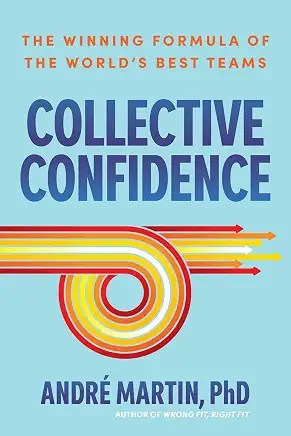
 Collective Confidence: The Winning Formula of the World´s B est Teams
Andre´ Martin
IT Revolution (September 2026)
Channeling Henry Ford: “Whether we think our team can succeed or think it can’t, we’re probably right.”
In their classic contribution to thought leadership in business, Judgment Calls (2012), Thomas Davenport and Brook Manville thoroughly explain HOW and WHY the most valuable teams make the best decisions. However different the nature and extent of the circumstances — as well as the implications and potential consequences of the given decision — may be, members of these teams follow essentially the same process, one that takes into full account four separate but related trends:
o The recognition that “none of us is as smart as all of us”
o Tapping not only the so-called wisdom of the crowd but also its leadership
o The use of data and analytics to support – sometimes even make – decisions
o Information technology that enables and then supports (indeed expedites) better decisions
No organization ever has too many great decision-makers. Indeed, few have any. However, I agree with Davenport and Manville that all organizations can establish and then constantly improve a collaborative process by which organizational judgment produces a much higher percentage of appropriate decisions. This does not require a Great Leader. Rather, it requires development of collective leadership (i.e. results-driven initiative) at all levels and in all areas. It also requires constant communication, cooperation, and (especially) collaboration. These are among the defining characteristics of a Great Organization.
Andre´ Martin could not agree more. In Collective Confidence, he stresses the importance of having teams whose members have total confidence in these separate but interdependent principles:
1. Confidence in the capabilities of the team leader and each of the other team members
2. Confidence in the value of what each member’s unique perspectives, skills, and experience can contribute to team success
3. Confidence in the momentum that can be generated (compounded) by success of low-stakes tasks
4. Confidence in the value of what can be learned from what other teams have achieved
5. Confidence in what collective (team) efforts can accomplish
6. Confidence in the value of “shared leadership” (shared recognition and credit)
Martin devotes a separate chapter to each of these. His analysis of dos and don’ts for you to keep in mind is especially rigorous and eminently pragmatic.
Members of all of the great teams that I have worked with or studied tend to think and behave in terms of first-person PLURAL pronouns. This is certainly true of the exemplars that Martin examines. They illustrate what he characterizes as “the Five Essential Team Processes”: Open Communication, Role Clarity, Recognition Systems, Ambitious (but Realistic) Goal Setting, and Constructive Conflict. That is certainly true of teamwork aboard the USS Honolulu, within IDEO, ZICO, and Jeff Conroy’s production crew in the Bering Sea, and at PeakSpan Capital.
It is also important to keep in mind that once a decision has been made, there will be new and sometimes even greater challenges when implementing the given plan. Resistance to change tends to be cultural in nature, the result of what James O’Toole aptly characterizes as “the ideology of comfort and the tyranny of custom.”
Those who share my high regard for this brilliant book are urged to check out Sprint: How to Solve Big Problems and Test New Ideas in Just Five Days, written by Jake Knapp with John Zeratsky and Braden Kowitz and published by Simon & Schuster.
* * *
Here are two suggestions while you are reading Collective Confidence: First, highlight key passages. Also, perhaps in a lined notebook kept near-at-hand, record your comments, questions, responses to various “Leader Action” exercises, and your own action steps (preferably with deadlines). Pay special attention to “The Collective Confidence Index Assessment” (Pages 41-47) and “The Five Essential Team Processes” material (54-57).
These two simple tactics — highlighting and documenting — will expedite frequent reviews of key material later.