 Here is an excerpt from an article written by and for Harvard Business Review. To read the complete article, check out others, sign up for email alerts, and obtain subscription information, please click here.
Illustration Credit: Biodiversity Heritage Library
* * *
But the world has changed since this model was perfected. In talking to and working with CEOs and senior executives at hundreds of companies, we came to realize that the typical corporation is rather like the Tin Man in The Wizard of Oz. He was a rigid and clumsy character, slow to move and react. He could take instructions but showed little initiative. Too often, we find organizations today in the same state Dorothy found him in—rusted solid, waiting for an outside fix of oil just to get moving again.
These companies, which we call “Tin Man Orgs,” were optimized for an era of mass production, adherence to process, and top-down planning. They struggle to cope with a complex world in which success depends on adapting and discovering—on building genuine, trust-based relationships with customers, employees, and their broader environment. Work today is less transactional and more relational. Customers have more choice, and so do employees. People don’t want to be managed; they want to be inspired. They don’t want to be told; they want to be heard.
What strikes us when we work with customers and leaders in Tin Man Orgs is that many know how they operate is holding them back. In response they have sought an escape through transformations, large-scale initiatives aimed at modernizing operations, embracing digital technologies, and cultivating agility. But despite the trillions companies have invested in these initiatives over the past two decades, the results are underwhelming: Just 12% of transformations create sustainable performance gains, even after three years.
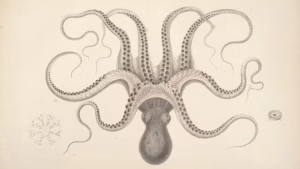
In this article we call for a fundamentally different paradigm: the Octopus Organization, inspired by the remarkably adaptive, curious, and intelligent sea dweller. That animal, whose arms can think and act independently yet work in perfect concert, offers a model for building companies that can thrive in complexity and embrace continuous change. Octopus Orgs tap the intelligence of their people, integrating a range of efforts naturally and gracefully. They sense subtle signals, learning and shifting course at speed to navigate uncertainty.
What’s Different About Octopus Orgs?
The need for the Octopus Org arises from a fundamental mismatch: Most companies are built for a complicated world, but the one they now inhabit is irrevocably complex. Understanding the distinction between these two states is crucial to grasping why traditional organizational models are faltering and why the Octopus Org offers a more viable path forward.
As systems theory informs us, a complicated world is one of blueprints and recipes. Think of a jet engine: It has thousands of parts and requires immense expertise to assemble, but its processes are knowable, repeatable, and produce a predictable result. If a part breaks, you find the root cause and fix it. This is the world the Tin Man Org was designed for, an environment where a company’s strategy can be optimized through analysis, specialization, and control, with no inherent uncertainty.
A complex world, however, is more like the ocean, the home of the octopus—where a small shift in the current can create unpredictable effects miles away. The shifts and unpredictability make it difficult to navigate; you can only sense, respond, and learn from the flow. This is the world the Octopus Org is designed for, an environment where success comes not from rigid control but from distributed intelligence, continuous learning, and adaptation.
To get a sense of what this looks like in a business setting, think of how most companies structure strategy meetings. The very design of the typical meeting room—dominated by a large screen for presentations, often with no whiteboard in sight—signals that it is a space for the consumption of information, not the creation of ideas. Speakers adhere to a set agenda, deliver carefully prepared slides, and stick to their allotted time. Questions are reserved for the end and are often perfunctory or performative. The information flow is tightly controlled and consistently structured.
In the Octopus Org, by comparison, meetings have clearly defined outcomes but not always a fixed agenda. Leaders encourage people to surface ideas rapidly and ask provocative questions. You’ll often find a diverse group from across the company—frontline workers and executives, new and tenured voices—gathered around a whiteboard. Contributors build on and challenge one another’s arguments. Conversation flows, tangents are explored, and unexpected connections emerge.
You can also spot the differences when you visit call centers. At a Tin Man call center, reps stick to scripts and decision trees dictated by an algorithm. The agent is a process executor held to metrics that reward the volume of resolutions. Over at the Octopus call center, meanwhile, agents own the customer’s problem. They actively listen, empathize, and tailor solutions to the individual, with a discretionary budget to ensure a good outcome. There’s a sense of human-centered problem-solving, of genuine connection. This feeling of ownership ignites a dissatisfaction with the status quo—an innate desire not just to solve the immediate problem but to hunt down its root cause. Octopus agents become innovators on behalf of customers, eliminating friction, automating away recurring issues, and building intelligent agents to handle entire categories of repeat problems—in other words, improving the organization itself.
And look at how Tin Man Orgs treat innovation as a department, creating innovation labs that are physically and culturally isolated. Teams develop ideas in isolation and then hand them off (along with all the integration and real-world challenges they haven’t accounted for) to “the business” for implementation. Octopus Orgs, in contrast, understand that innovation is a distributed capability, the daily, obsessive work of meeting customer needs in ever better ways. They create mechanisms for invention everywhere, entrusting small, decentralized teams with end-to-end ownership of customer problems. This ensures the people closest to the customer are the ones who experiment, learn, and build what’s coming next.
Ultimately, all of these Octopus Org behaviors—from how they hold meetings to how they run call centers—orbit around a single, nonnegotiable question: “Does this create more value for our customers?” Asking it relentlessly causes a chain reaction. The obsessive focus drives employee engagement because people can see a direct link between what they do and the impact they have on customers, which in turn fuels the innovation and resilience needed to thrive. The rewards are cultural, profound, and measurable. Research shows that customer-obsessed companies not only are more than three times as likely to lead their industries in revenue growth but also achieve profitability premiums of around 23% over their Tin Man peers.
* * *
Here is a direct link to the complete article.