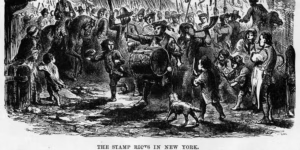
 Here is a brief excerpt from an article written by Patrick J. Kiger that is featured at the History.com website. To read the complete article, please click here.
Published: August 20, 2019: Last Updated: May 28, 2025.
Illustration Credit: Ed Vebell/Getty Images
Here are the first three of seven key events.
* * *
Colonists didn’t just take up arms against the British out of the blue. A series of events escalated tensions that culminated in America’s war for independence.
1. The Stamp Act (March 1765)
To recoup some of the massive debt left over from the war with France, Parliament passed laws such as the Stamp Act, which for the first time taxed a wide range of transactions in the colonies.
“Up until then, each colony had its own government which decided which taxes they would have, and collected them,” explains Willard Sterne Randall, a professor emeritus of history at Champlain College and author of numerous works on early American history, including Unshackling America: How the War of 1812 Truly Ended the American Revolution. “They felt that they’d spent a lot of blood and treasure to protect the colonists from the Indians, and so they should pay their share.”
The colonists didn’t see it that way. They resented not only having to buy goods from the British but pay tax on them as well. “The tax never got collected, because there were riots all over the place,” Randall says. Ultimately, Benjamin Franklin convinced the British to rescind it, but that only made things worse. “That made the Americans think they could push back against anything the British wanted,” Randall says.From the 1760’s onward, colonial anger grows as the British pass a series of taxes and laws. With each one, the two groups move closer to war.
2. The Townshend Acts (June-July 1767)
Parliament again tried to assert its authority by passing legislation to tax goods that the Americans imported from Great Britain. The Crown established a board of customs commissioners to stop smuggling and corruption among local officials in the colonies, who were often in on the illicit trade.
Americans struck back by organizing a boycott of the British goods that were subject to taxation and began harassing the British customs commissioners. In an effort to quell the resistance, the British sent troops to occupy Boston, which only deepened the ill feeling.
3. The Boston Massacre (March 1770)
Simmering tensions between the British occupiers and Boston residents boiled over one late afternoon when a disagreement between an apprentice wigmaker and a British soldier led to a crowd of 200 colonists surrounding seven British troops. When the Americans began taunting the British and throwing things at them, the soldiers apparently lost their cool and began firing into the crowd.
As the smoke cleared, three men—including an African American sailor named Crispus Attucks—were dead, and two others were mortally wounded. The massacre became a useful propaganda tool for the colonists, especially after Paul Revere distributed an engraving that misleadingly depicted the British as the aggressors.
* * *
Patrick J. Kiger has written for GQ, the Los Angeles Times, National Geographic, PBS NewsHour, and Military History Quarterly. He’s the co-author (with Martin J. Smith) of Poplorica: A Popular History of the Fads, Mavericks, Inventions, and Lore that Shaped Modern America.