 Here is an excerpt from an article written by for Harvard Business Review. To read the complete article, check out others, sign up for email alerts, and obtain subscription information, please click here.
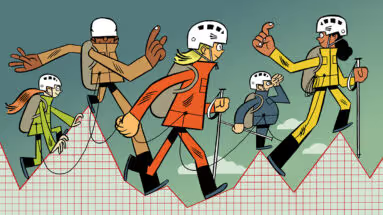
Illustration Credit: Jason Ford
* * *
In their new Harvard Business Review Press book, All the Difference: Six Leadership Actions to Bridge Perspectives, Strengthen Teams, and Create Value, Susan MacKenty Brady, Stuart D. Kliman, and Leslie C. Smith argue that difference is the raw material for creating value—but only if leaders know how to harness it. This article is adapted from the book.
Organizations are incredibly diverse today, in every sense of the word. Teams span generations, cultures, functional specialties, educational backgrounds, political perspectives, and increasingly, different relationships with technology and AI. Work is more distributed, expectations are more personalized, and the pace of change continues to accelerate. Leaders are asked to unite people who see the world differently, solve increasingly complex problems, and move quickly despite uncertainty. Yet many organizations continue to struggle to capture the full value of the differences already present in their workforce.
The problem is not difference itself. Difference is often the source of innovation, adaptability, better decision-making, and stronger problem solving. The challenge is that human beings are not naturally equipped to navigate difference without friction. When perspectives collide, when assumptions are challenged, or when tensions arise, leaders often fall into predictable behavioral traps. These traps quietly erode trust, weaken collaboration, and diminish performance. We call them leadership “landmines”—hidden dynamics that can derail even the most well-intentioned leaders.
This realization came not only from our experience working with all kinds of leaders and teams, but also emerged through our own partnership. One of us spent nearly four decades leading soldiers in some of the world’s most complex environments. Another has spent his career helping organizations negotiate, collaborate, and solve high-stakes challenges. The third has devoted her career to developing leaders as an executive coach, and as CEO of a leadership institute. Coming to this work from different professions, experiences, and ways of seeing the world, we have experienced firsthand how quickly thoughtful, well-intentioned people—including ourselves—can interpret the same situation in entirely different ways. Those moments became the source of our best thinking and reminded us that difference is not what creates dysfunction. It is how we respond to difference that determines whether value is created or diminished.
Understanding these landmines is the first step toward turning difference from a source of friction into a source of value.
Four Landmines That Derail Leaders
[Here’s the first.]
Certainty.
The first and perhaps most common landmine is certainty—the conviction that our interpretation of a situation is the correct one and that opposing viewpoints are simply mistaken.
Every leader has experienced this. A strategic debate emerges. One executive argues for aggressive investment; another insists on cost containment. One team member advocates rapid action; another urges caution. Before long, the discussion stops being about exploration and starts becoming a contest over who is right.
The challenge is that people attend to different information, draw on different experiences, and interpret events through different mental lenses. Two intelligent, well-informed people can look at the same situation and reach different conclusions.
We recall working with an executive team where one member, Asher, felt a strong need to focus planning discussions on making the next quarter’s numbers, yet his colleague, Jen, wanted to look farther ahead toward a strategy that would better equip the business to grow over the long term. Each strongly believed they were right, and the other wrong, given the context of the situation.
Any of us can think of a conversation or issue we felt absolutely certain about. The evidence seemed clear. The conclusion felt obvious. Anyone who saw the situation differently appeared to be missing something important. It is precisely in these moments of confidence that certainty becomes dangerous, because conviction quietly replaces curiosity.
Certainty feels efficient because it creates clarity. But it often closes off the very conversations that generate breakthrough thinking. Leaders who become overly attached to being right risk leaving valuable perspectives—and valuable solutions—on the table.
* * *
Here is a direct link to the complete article.